
EVEN TREES PLAY CHESS
(…and they play damn well!)
Among the various climate mitigation strategies, planting trees is one of the few tools at our disposal; it is cheap, widely applicable, effective and commonly supported. Estimates suggest a global potential for forest restoration capable of sequestering several billions of tons of CO₂ per year (1), and reforestation has been incorporated into the climate strategies of companies, individual citizens, and even some governments. However, planting trees is ineffective if, at the same time, existing forests are being cut down. This is a crucial point that is rarely highlighted—and, in practice, it is violated. Systematically.
An old-growth forest contains two to three times the amount of carbon stored in a young forest (2). When a mature forest is cut down, approximately 60% of the stored carbon is released into the atmosphere almost immediately as CO₂—through the decomposition of the residues, as well as the transport, processing, and eventual disposal of wood products. The impact in terms of carbon emissions is immediate, while the "credit"—in the form of new trees planted elsewhere—arrives only after a delay that can be measured in decades. A comparative study over ponderosa pine forests in Oregon quantified this gap: the intact forest held approximately 21 kg of carbon per square meter, whereas the trees planted to replace the original ones contained only 10 kg of carbon. A retrospective simulation estimated that the regrowth period required to recover the carbon lost from such logging ranges between 50 and 100 years (3).
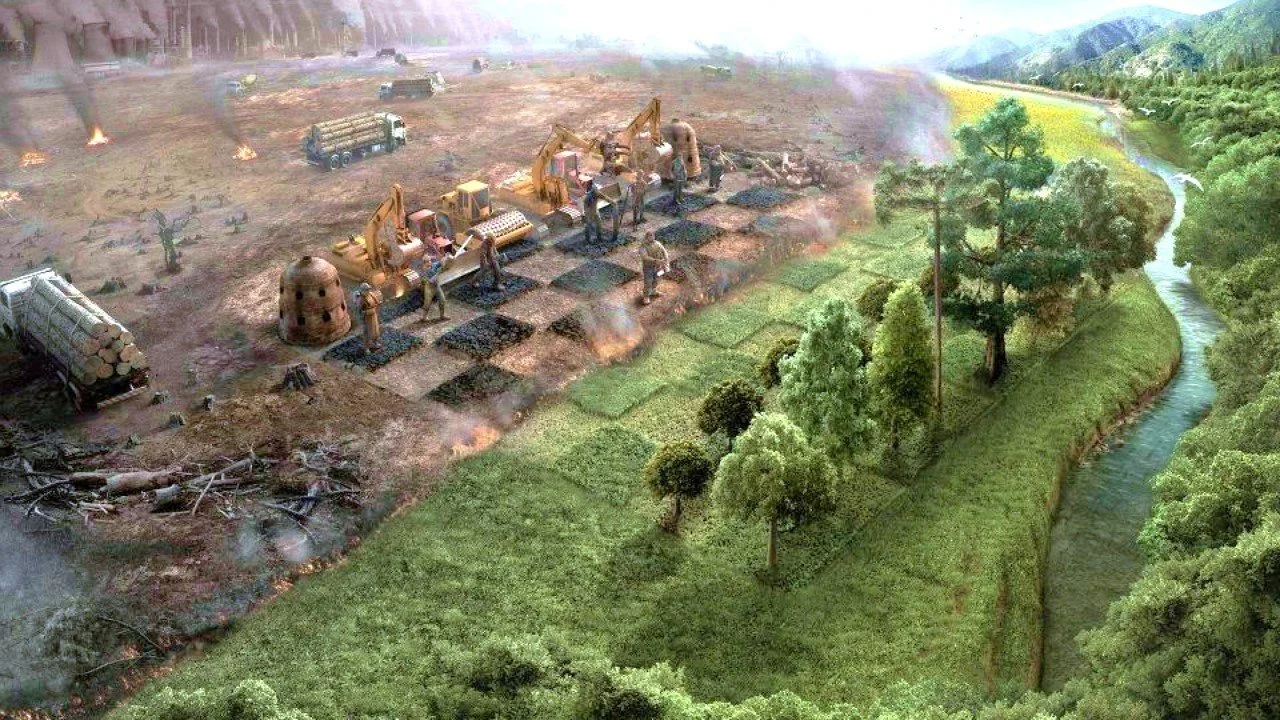
These numbers describe a flawed chess move, made by someone who only sees the piece being sacrificed—in pursuit of a presumed, yet ultimately ephemeral, advantage—without the capacity to view the chessboard as a whole. On one side sits the man, laying their faith in action, in compensation, and in the accountancy that always balances the corporate ledger—driven by the arrogant logic of an ideology that has turned the predatory exploitation of resources into a veritable way of life. On the other side sits nature, which adheres solely to the rules dictated by mathematics, physics, and biology. The game appears simple: the man is willing to sacrifice a piece—in the form of a few old trees—while promising to replace it with another one, a sapling that will one day be worth as much as the one that was lost. Yet, this is precisely a way of breaking the rules.
In a game of chess between humans, sacrificing a piece requires the match to last long enough for that loss to be compensated by a strategic gain. And it’s precisely here that the weakness of the human strategy is exposed when nature sits on the other side of the board. One of the rules of the game concerns the time horizon; yet, the man makes decisions by watching through a lens that distorts perspective—focusing on a timeframe that never aligns with the one of carbon. It is as if the man was playing chess with the temporal (and strategic) horizon of a tic-tac-toe game, while nature keeps it in a state of constant check—after all, nature has known the rules for millions of years.
And here lies the ironic twist that perfectly illustrates the scale of the man’s error when they sit down at the gaming table.
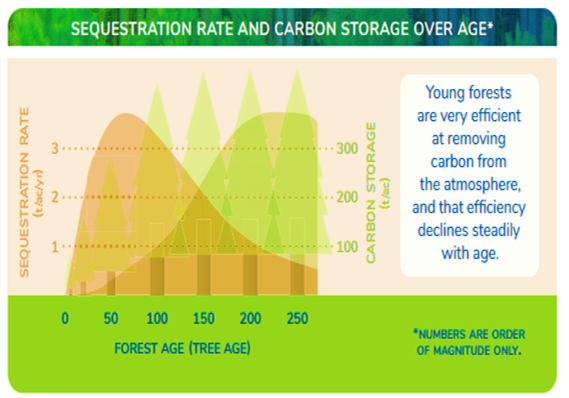
In terms of the annual exchange between photosynthesis and respiration, an old forest is far closer to neutrality than a young forest (4). When we think of a tree absorbing CO₂, we tend to picture a young plant growing and accumulating biomass; a mature forest, instead, exists in a state of near-equilibrium—the CO₂ that it absorbs through photosynthesis is roughly equal to the amount that it releases through respiration and the decomposition of leaves and dead wood (5). It is estimated that our planet is home to just over 3 trillion trees (6), the vast majority of which is made up of ancient or mature forests. While these forests may not be highly efficient at sequestering new carbon, they serve as massive reservoirs of CO₂—amounting to some 400 billion tonnes (or over 600 billion tonnes if we consider the entire forest ecosystem)—accumulated over centuries in the form of wood, roots, and undecomposed organic matter. Left alone, such forest is quiet; it breathes, grows slowly, and maintains a balance that may seem static to us. But if you cut it down, all that carbon is released at once—much like a detonator that has remained dormant for as long as it took for that area to become a forest in the first place.
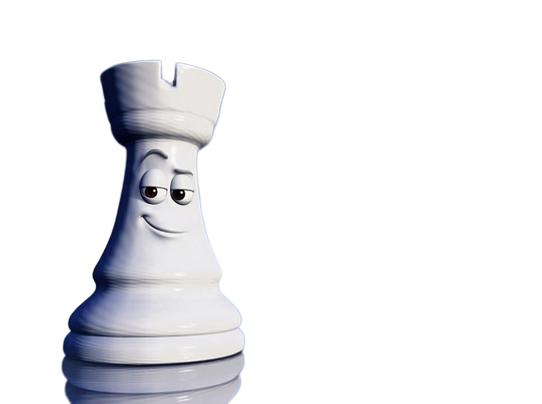
A mature forest, then, is the chess piece that looks motionless and harmless - so much so that no one would ever expect it to be so pivotal - much like a rook that remains still throughout the entire game, only for us to realize, in the end, that it had been controlling the whole board from the very start. An old-growth forest is the rook that nature keeps in a static, seemingly harmless state, which we humans constantly underestimate because we fail to grasp its potential, a potential that, within our metaphor, is strategic to the game. We see a piece that does not move, that seems to serve no active function, and we assume we can ignore it - or even outmaneuver it - convinced that our current strategy is superior to the threat posed by our “opponent’s” rook - to remain within the metaphor. And this is precisely when nature punishes us, because we failed to understand what we were actually attacking. A mature forest is the piece that we can’t ignore, for its capture cannot be compensated by any “winning” strategy. Nature constantly leads us to believe that any damage can be offset by a strategic advantage - and we fall for it every time.
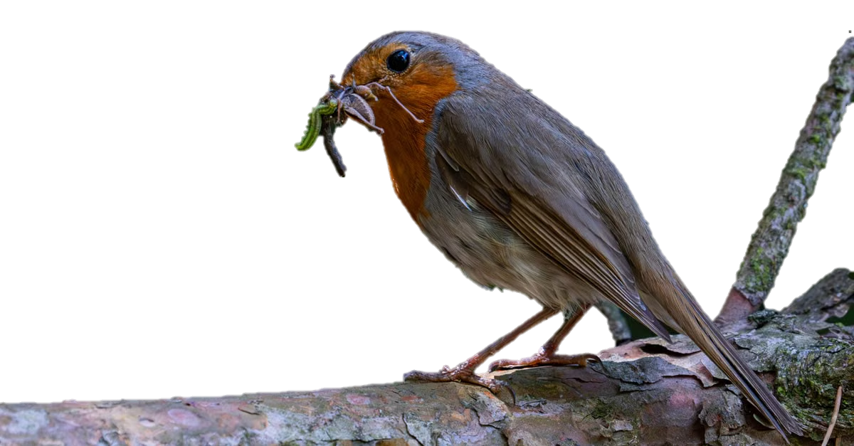
Not to mention the fact that humans are destroying an entire ecosystem - one with a diverse fauna that has adapted to that specific environment over the course of centuries. The new trees planted to compensate for the forests that have been cut down cannot, for a very long time, replicate the functions of the original forest. At least in the initial phase - if time even allows for a subsequent phase to be reached - they will merely be a plantation of trees, possessing only a fraction of the original biodiversity, and persisting for a span of time that none of us will live to see. Old-growth, structurally complex forests serve as shelters for species that cannot adapt elsewhere; these species would inevitably vanish along with the forest the moment it is cut down (7).
To better understand how structurally shortsighted the human strategic vision is, there’s a phenomenon that makes the chess metaphor even more realistic.
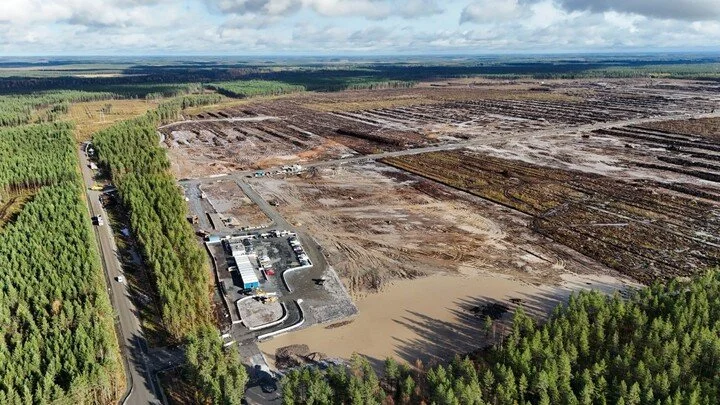
Aerial photo of the site in Muhos (Finland) where Google plans to build a data center
In Finland, Google had approximately 400,000 trees cut down at two sites destined to the construction of data centers for artificial intelligence. In Muhos, 330 hectares of forest were cleared to create bare land; an estimated 150,000 additional trees were removed at the Otanmäki site (8). These operations began before the mandatory environmental impact assessments were completed, and Finnish authorities halted the work. Google has then apologized and promised to replant trees across 130 hectares at the Muhos site. Needless to say, this promise does not balance the scales - it makes the overall outcome significantly worse.
But here a second, even deeper level of error emerges: a data center is not merely an infrastructure that devastates the land and the atmosphere by occupying space and consuming energy; it is a shell containing "disposable" technology - truly disposable! While the structure’s shell is designed to last decades, the silicon and the technology within it age at a pace that bears no relation to the maturation rate of any forest, whether ancient or young. An analysis by Allianz Trade estimates that global data center emissions in 2025 reached 286 million tons of CO₂ - an amount equal to the total emissions of Italy for that same year (just under 288 million tons)(9). The paradox is clear: human-driven deforestation, whether on a large or small scale, destroys an ancient, well-established entity in favour of one that is already obsolete the moment it comes into existence. A data center is like a chess piece whose tactical value depreciates the very instant you touch it to make a move; a mature forest, instead, is a piece that might seem almost useless, until you realize, only after it is gone, that it was indispensable.
In our example, the Data Center demonstrates that the chess metaphor - much like it does for many other aspects of our existence - aptly describes what happens when one plays against an opponent who is in no rush and makes no errors in timing or calculation. Meanwhile, we humans, convinced that we are acting in our own best interest, counter with moves that are tactically and strategically idiotic against a strategy that has evolved over centuries. It is patently clear that we still haven’t understood what game we are actually playing; if we were to attempt to play it with even a modicum of seriousness, we would realize that we are up against an opponent who plays damn well!
Our strategy may seem clever - but only on the surface - because human guilt is a powerful lever, and the symbolic compensation offered by actions that attempt to restore an environment we are currently destroying serves to soothe our conscience, making the damage we have caused easier to bear. “If I cut down a forest, I can always plant new trees; if I have emitted CO₂, I can always find a way to absorb an equivalent amount.” The accounting might seem to make the ends meet, but carbon accounting does not work like corporate bookkeeping.
The state of perpetual checkmate in which humanity finds itself is simply the consequence of a failure to foresee. Scientific literature, for its part, is very clear on this: the truly clever move - the most effective, the most immediate, and, at the same time, the least costly - is twofold and non-negotiable: planting new trees in degraded areas while simultaneously protecting existing forests, rather than sacrificing them to sustain an economic model justified by the false presumption of progress. Nature has never left the gaming table; it has never broken this fundamental rule, and even today, it continues to offer its opponent the chance to keep playing. We can only hope that the opponent realizes this.
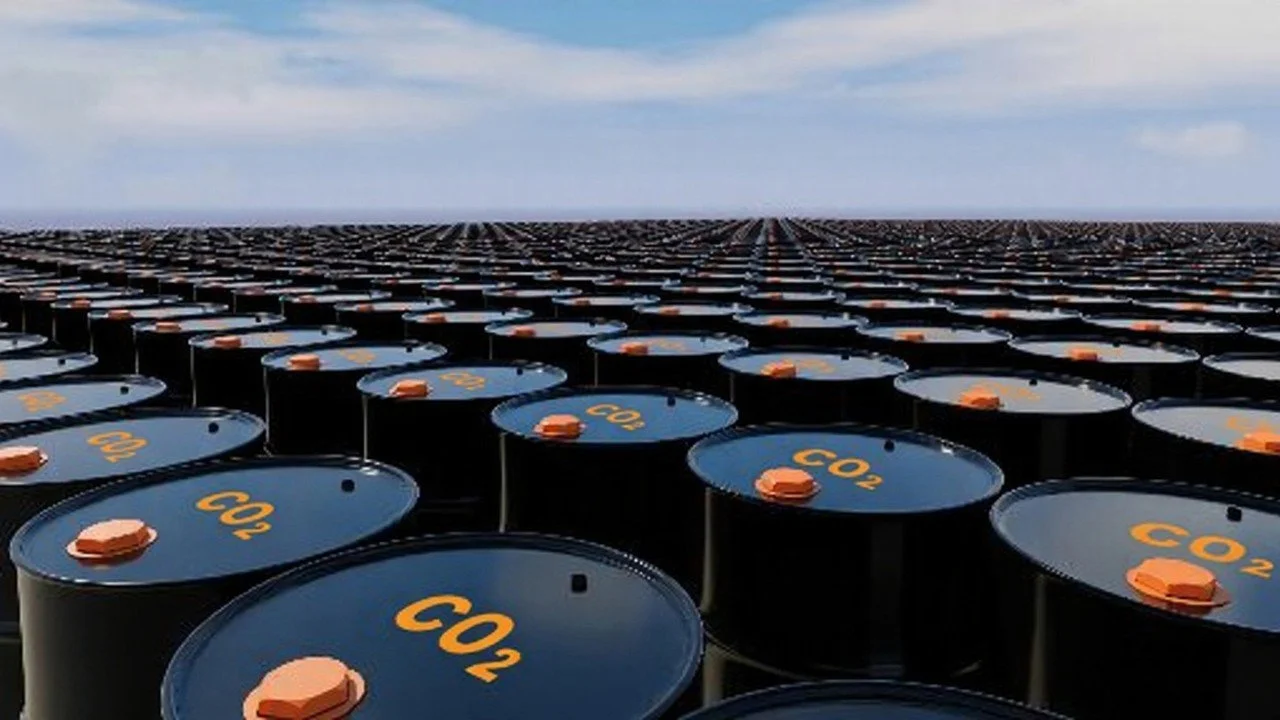
Now, let’s think about this narrative, the game of chess we envisioned in this article, alongside the forests humans are clearing, the wildlife, and the data centers that stand as the technological frontier of our current era - indeed, of these very months! Let us now project this same logic back in time, for it applies equally to a far more ancient history, dating back millions of years, long before humanity set foot on this planet. Back then, nature had done something with fossilized carbon remarkably similar to what it does today with an old-growth forest: it had immobilized it. For millions of years, the remains of living organisms had laid “hibernating” in solid or liquid form, effectively removing carbon from the atmosphere and locking it away in a kind of colossal reservoir, here again, a reservoir made inert by its defused detonator’s timer. Then came humanity; we evolved, asserting our presence and supremacy through progress, above all, through technology. And ultimately, we chose to restart that timer, though certainly not for the sake of technology, for had that truly been the reason, humanity would surely have played its game of chess with far greater brilliance.
